Is Your Credit Card Quietly Stealing From You Every Single Day?
Here’s an uncomfortable question: if you’re carrying a balance on your credit card right now, do you actually know how much that debt is growing today? Not this month. Not this year. Today.
Most people don’t. And that’s exactly how credit card companies like it.
Interest on your card isn’t some mysterious once-a-month fee that appears out of nowhere. It’s calculated every single day, quietly compounding in the background while you go about your life. Understanding how it actually works is one of the simplest ways to stop losing money without even realizing it and in this article, we’ll break it down in plain English, no finance degree required.
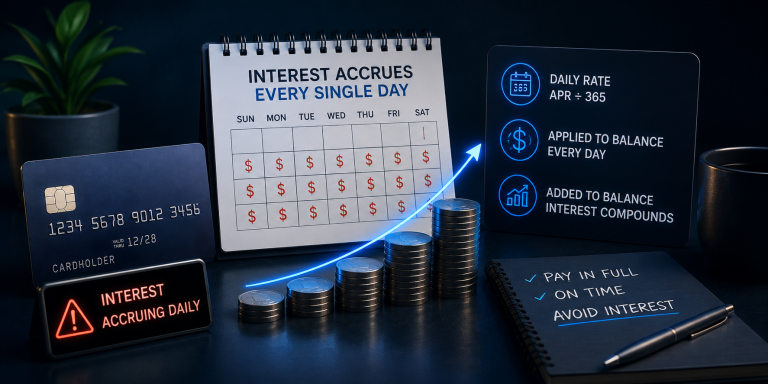
The key idea: your APR is an annual rate, but your card can use a daily or other periodic rate to determine interest. That means the size of your balance, how long you carry it, and the terms of your card all matter.
What APR Actually Means (Without the Jargon)
You’ve probably seen APR, or Annual Percentage Rate, on credit card offers. It represents the yearly cost of borrowing money, expressed as a percentage.
That doesn’t mean your card simply charges the full APR once a year. Credit card issuers generally convert the APR into a periodic rate, which may be used to calculate interest based on your balance during the billing cycle.
For cards that use a daily periodic rate, a simple way to estimate that rate is to divide the APR by 365.
Simple example
24% APR ÷ 365 ≈ 0.0658% per day
That number looks small. The important point is that a small daily rate can become a meaningful cost when a large balance remains outstanding for a long time.
How Daily Interest Is Actually Calculated
Let’s make this concrete.
Imagine you have a $1,000 balance on a card with a 24% APR.
A simplified calculation would look like this:
But don’t mistake that $0.66 figure for the exact amount your statement will necessarily charge. Credit card issuers use the calculation method described in your card agreement, and the balance used for the calculation can change throughout the billing cycle.
Many cards use an average daily balance method. Instead of looking only at what you owe on the final day of the billing cycle, the issuer considers your balance throughout the cycle and calculates interest based on the applicable average.
This creates an important practical point: when you reduce a balance can matter, not just how much you reduce it. Paying down a balance earlier can reduce the balance that is used for interest calculations during part of the cycle, depending on your card’s terms.
Why the Balance You Carry Matters More Than the APR Alone
People often focus on the APR because it is the number printed most prominently on a credit card offer. But APR is only one part of the equation.
A 24% APR on a small balance is a very different financial problem from a 24% APR on several thousand dollars. Likewise, two people with the same balance and APR can pay very different amounts of interest if one pays the balance down quickly while the other keeps it outstanding for years.
Balance
A larger balance generally means more dollars are exposed to interest.
APR
A higher rate increases the cost of carrying the same balance.
Time
Keeping debt outstanding longer gives interest more time to accumulate.
That is why simply asking, “What’s my APR?” isn’t enough. A better question is: “How much am I likely to pay to carry this balance under my card’s actual terms?”
The Grace Period: How Paying in Full Can Save You Interest
Here’s one of the most important concepts to understand: the grace period.
Many credit cards give you a grace period on purchases. If you pay your statement balance in full by the payment due date, you generally won’t pay interest on those purchases.
However, grace-period rules vary by card and by the type of transaction. Your card agreement is the final word.
Things can also change when you stop paying your statement balance in full. Depending on the card’s terms, you may lose the purchase grace period and begin accruing interest on new purchases as well.
That’s why checking the terms of your specific credit card matters before assuming that paying only part of the balance will work the same way as paying it in full.
A useful distinction: your statement balance is not necessarily the same thing as your current balance. The statement balance is the amount shown on your most recent statement, while the current balance can include transactions made after that statement closed.
What Happens If You Carry a Balance?
Let’s say you have a $1,000 balance at 22% APR and stop adding new purchases.
You aren’t just dealing with the original $1,000 anymore. Interest continues to be charged according to your card’s terms while the balance remains unpaid.
The longer you take to repay the balance, the more you can end up paying in interest. And if new purchases are added while you are trying to repay the old balance, the amount you owe can become much harder to bring down.
Why Minimum Payments Can Keep You in Debt Longer
This is where many people misunderstand credit card debt. A minimum payment can keep your account from becoming past due, but it does not necessarily mean you’re making meaningful progress toward eliminating the balance.
If the required payment is relatively small compared with the balance and interest being charged, a large portion of each payment can effectively go toward the cost of carrying the debt rather than rapidly eliminating the principal balance.
Your credit card statement should show information such as your minimum payment, balance, APR and, in many cases, an estimate of how long repayment could take if you make only minimum payments.
What to check on your statement
- Current or statement balance
- Purchase APR and any other applicable APRs
- Minimum payment due
- Payment due date
- Interest charges and fees
- Any repayment estimate provided by the issuer
Common Mistakes That Can Increase Your Interest Costs
Cash Advances
Cash advances can have different terms from ordinary purchases. They may come with a higher APR and often begin accruing interest immediately rather than receiving the same grace period as purchases.
Always check the terms before using your credit card to withdraw cash. A transaction that feels similar to an ordinary purchase can carry a very different cost.
Paying Late
Missing your payment due date can result in late fees and potentially other consequences depending on your card agreement.
A late payment can also affect your credit history if it becomes sufficiently delinquent, so setting up reminders or automatic payments can help prevent avoidable mistakes.
Balance Transfers
Balance transfers can be useful for managing existing debt, but they aren’t automatically free.
Cards may charge a balance-transfer fee, and promotional rates eventually expire. Some cards also have specific rules about when interest applies.
Before transferring a balance, compare the fee, promotional period and regular APR. A lower promotional rate does not automatically mean the transfer will save you money.
Only Paying the Minimum
Making the minimum payment can keep your account from becoming past due, but it can also leave you carrying debt for a long time.
If you can afford to pay more than the minimum, doing so can reduce your balance faster and potentially reduce the total interest you pay.
How to Reduce the Interest You Pay
If you’re already carrying a credit card balance, there are a few practical steps worth considering. You don’t need a complicated strategy. The biggest gains usually come from reducing the balance, avoiding unnecessary new charges and understanding the terms of the account.
Pay more than the minimum whenever you can.
Additional payments can reduce the balance faster, which can reduce the amount exposed to interest over time.
“`
Stop adding new purchases to a balance you’re struggling to repay.
It is difficult to make progress when new spending continually replaces the balance you just paid down.
Make payments earlier when possible.
For cards that use an average daily balance method, reducing your balance earlier may reduce the balance used in the interest calculation.
Check your card’s APR and fees.
Knowing the actual terms of your account makes it easier to understand what carrying the balance is costing you.
Consider whether a lower-interest option could make sense.
If you consider a balance transfer or another borrowing option, compare the fees, promotional period, ongoing rate and repayment terms rather than focusing on one number.
“`
A Better Way to Look at Your Credit Card Balance
Instead of thinking about a credit card balance as one large number, break it into three questions:
- How much do I owe? This tells you the size of the problem today.
- What rate am I paying? Your APR helps determine the cost of carrying the balance.
- How quickly can I realistically reduce it? This determines how long the balance remains exposed to interest.
That third question is often overlooked. Someone who cannot eliminate a balance immediately can still make meaningful progress by creating a repayment amount that is realistic and consistently larger than the minimum whenever their budget allows.
The practical goal
Don’t focus only on avoiding today’s interest charge. Focus on reducing the balance that can generate tomorrow’s interest.
Frequently Asked Questions
Does credit card interest really accrue every day?
Many credit cards calculate interest using a daily periodic rate or another periodic method, but the exact calculation depends on the card agreement. Your issuer’s terms determine how interest is calculated and when it is charged to the account.
Does paying my credit card early reduce interest?
It can, depending on how your card calculates interest. If your card uses an average daily balance method, lowering the balance earlier can reduce the balance used in the calculation for part of the billing cycle.
Is APR the same as the interest rate I pay each day?
No. APR is an annualized rate. A card may convert that rate into a daily or other periodic rate for calculating interest. Dividing APR by 365 is a useful simplified estimate for a daily rate, but it does not replace the calculation method in your card agreement.
Can I avoid credit card interest completely?
If your card offers a grace period for purchases and you meet its requirements, paying the statement balance in full by the due date can generally allow you to avoid interest on those purchases. Different transaction types can have different rules, so check your card’s terms.
Why does my balance sometimes seem to barely move?
Interest, fees and new purchases can offset part of your payment. If the payment is only slightly larger than the amount being added to the balance, the debt can take much longer to disappear.
The Takeaway
Credit card interest isn’t complicated once you understand how the calculation works, but it can become expensive when a balance sticks around for months or years.
The simplest way to avoid purchase interest on a card that offers a grace period is generally to pay your statement balance in full by the due date.
If you can’t pay in full, don’t panic. Understanding your APR, making more than the minimum when possible, and paying down the balance consistently can help you reduce the amount of interest you pay over time.
One final check: before making decisions about your credit card, look at the actual agreement and latest statement for your account. APRs, fees, grace-period rules and calculation methods can differ between cards.